- Paint my Room
- Guides
- Choosing color
Accent walls: which wall, which color
Paint the wall your eye already lands on, behind the bed, behind the sofa or facing the door. Choose a color a few steps deeper than the rest with the same undertone, and preview it in your own room before buying a tin.
 Erik, Chief Colour Officer · 2 min read
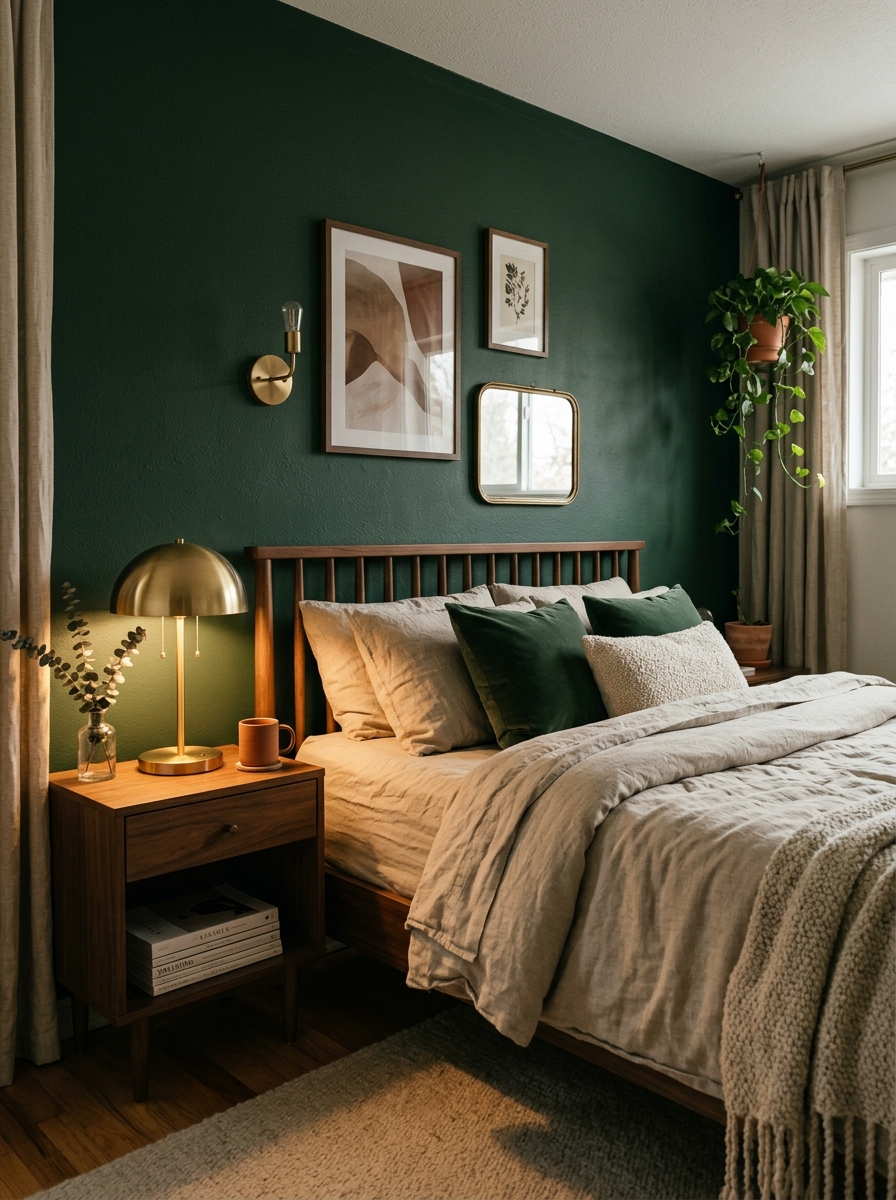
An accent wall is the cheapest way to change a room's character, one wall and one tin. It is also easy to get wrong. Most failed accent walls are not the wrong color. They are the wrong wall.
Which wall should be the accent wall
Walk into the room and notice where your eye lands first. That is your accent wall. In a bedroom it is almost always the wall behind the headboard. In a living room it is the wall behind the sofa, or the one with the fireplace or TV. In a hallway it is the far wall you walk toward.
The accent color strengthens a focal point the room already has. Painting a random side wall creates a second focal point that fights the first.
Which wall to avoid
Skip the wall with the main window. When you face it, you are looking straight into daylight, and the wall around the window falls into shadow by comparison. Even a bright color reads dark and dull there.
Also avoid walls broken up by several doors or openings. An accent color needs a calm, mostly uninterrupted surface, or it looks like scattered patches rather than a feature.
How to choose the accent color
The safest accent is a deeper version of the color family already in the room. If the walls are a warm off-white, a warm clay or olive will feel connected. If the walls are a cool grey, a deep blue or green with a grey base will sit better.
The rule is shared undertone. Warm with warm, cool with cool. Then go two or three steps deeper on the strip, so the difference is clearly intentional rather than looking like a slightly different white.
Accent wall colors that work in most rooms
- Deep green behind a bed or sofa feels calm and grounded, and suits wood and brass.
- Terracotta and clay add warmth, especially in north-facing rooms that feel cold.
- Navy gives a quiet, tailored backdrop for art and lighter furniture.
- Dusty pink softens a bedroom without feeling childish when kept muted.
Whatever you choose, check it against your floor and your biggest piece of furniture. Those two set the undertone of the room more than the other walls do.
See the accent wall before you paint it
The success of an accent wall depends on the walls around it, so a chip in your hand is the worst possible test. Take a photo of the room and preview the color on the one wall you plan to paint. Paint my Room lets you try colors on your own walls from a single photo, so you can compare three accent options in place and buy only the winner.
Questions people ask
Should an accent wall be darker or lighter than the other walls?
Darker in almost every case. A deeper accent wall reads as a deliberate feature and adds depth. A lighter accent wall against darker walls tends to look like the wall was simply missed, unless the whole room is dark and you want one wall to glow.
Is an accent wall still in style?
Yes, but the approach has changed. Bright contrast walls are less common. Today accent walls lean deeper and more muted, greens, clays and blues that share the room's undertone, so they feel like part of the scheme rather than a splash of color.
Can I paint an accent wall in a small room?
Yes. A deeper color on the far wall of a small room can make it feel further away. Keep the other walls light and with the same undertone, and avoid accenting a wall that already has a window or several doors in it.
Should the ceiling match the accent wall?
Usually no. The ceiling normally follows the main wall color or a soft white sharing its undertone. Carrying the accent color onto the ceiling turns the room into a partial color drench, which can work, but it is a different effect from an accent wall.
Sources
- Color wheelon how colors relate, useful for choosing an accent that shares a family with the room.
- Color temperatureon why a wall facing the window reads darker than the same color elsewhere.
See the color on your walls first
Paint my Room paints a photo of your own room in any color, with its light and shadow kept. Free to download on iPhone, iPad and Android.